

We help procurement teams read a resin datasheet the way the toolroom reads it. Melt flow rate sits on one line, yet it shapes gate size, wall limits and press choice. Five official datasheets show why the condition next to the number decides whether that number can be compared at all.
The melt flow line sits near the top of every datasheet, and it still causes confusion on both sides of a quotation. Buyers ask why one supplier picked a different grade. Toolmakers ask why the drawing names a family instead of a grade. The line itself looks simple: one number, one unit. It hides the part that matters.
One camp treats a high flow number as a free pass to thin walls and small gates. The other camp distrusts the value completely and relies on trial and error. Both camps read the number. Neither camp reads the condition column beside it, and the condition is what makes the number usable.
The conflict shows up in the datasheets themselves. Five official grades we checked list four different test loads and three different melt temperatures. Two numbers taken under different settings cannot be ranked, yet purchase decisions get made on exactly that comparison.
We set out to answer four questions:
- What does melt flow rate actually measure?
- Why does the highest number not mean the easiest fill?
- How does melt flow change the tool and the machine?
- Which three lines should a mould RFQ carry?
Based on the five datasheets and the two processing guides behind this article, the answer is short: read the condition first, then the number. The one pair that compares honestly sits in plain sight — unfilled PA66 at 40 cm³/10 min against glass-filled PA66 at 30, both at 275 °C/5 kg under ISO 1133. Everything else in the table travels with a different test setting, and the tooling rules below show what that number does to gates, walls and presses.
Key takeaways
- One condition, honest comparison: unfilled PA66 flows 40 cm³/10 min and PA66-GF30 flows 30 at the same 275 °C/5 kg setting per ISO 1133 — glass fibre cuts flow by a quarter.
- Four settings across five sheets: test loads of 1.2, 2.16, 3.8 and 5 kg at 230–300 °C; numbers taken at different settings cannot be ranked.
- Nozzle pairs with gate: the LANXESS processing guide sets the nozzle aperture at gate diameter minus 0.5 to 1.0 mm.
- Flow caps thin walls: the DuPont design guide works a 0.050 in wall down to 0.020 in only where melt flow allows it.
- Three lines make an RFQ quotable: grade, MVR with its condition and the datasheet itself fix the gate class before pricing starts.
Methodology
Every flow value in this article traces to a resin maker document, not to a forum post or another mould maker blog. Four sources were fetched directly and returned HTTP 200: the Covestro Makrolon 2558 product page, the INEOS Styrolution Terluran GP-22 shop page, and two BASF Ultramid datasheets, A4H and A3EG6, from the official download server. The fifth, the SABIC PP product page, refuses automated requests from our network, so the value was verified through the official-domain search result instead.
The tooling rules come from two processing guides: the LANXESS Processing data for the injection molder and the DuPont General Design Principles guide. The tables below keep those two kinds of figures apart. Datasheet rows are grade-level typical values from the maker. Guide rows are engineering rules of thumb from the processor literature. Facts about our own floor enter this article only where they belong: a moulding hall of eleven presses rated 80–450 T of clamping force, five CNC machines with spark erosion and grinding beside them, and a CMM room downstream. Where a value is neither, it is labelled as general practice. The Limitations section lists the caveats in full.
What does melt flow rate actually measure?
Melt flow rate measures how much polymer passes through a standard die in ten minutes under a fixed melt temperature and a fixed weight. MFR reports grams per 10 minutes, MVR reports cubic centimetres per 10 minutes. The test methods behind the two notations are ISO 1133 and ASTM D1238. A higher value means a thinner, easier-flowing melt.
The five grades below were chosen because each maker publishes the value with its full condition line. Read the whole row, not just the flow column.
| Resin grade | Flow value | Test condition | Method | Source document |
|---|---|---|---|---|
| PP · SABIC 500P | 3 g/10 min | 230 °C / 2.16 kg | ISO 1133 | SABIC PP product page |
| ABS · Terluran GP-22 | 4.8 cm³/10 min | 230 °C / 3.8 kg | ASTM D1238 | INEOS Styrolution shop page |
| PC · Makrolon 2558 | 14 cm³/10 min | 300 °C / 1.2 kg | ISO 1133 | Covestro product page |
| PA66 · Ultramid A4H | 40 cm³/10 min | 275 °C / 5 kg | ISO 1133 | BASF datasheet |
| PA66-GF30 · Ultramid A3EG6 | 30 cm³/10 min | 275 °C / 5 kg | ISO 1133 | BASF datasheet |
Read the load column before the flow column. The same resin scores differently at 2.16 kg and at 5 kg. A number without its condition is not a number.
Why does the highest number not mean the easiest fill?
Scan the table and the PC value of 14 looks slower than the PA66 value of 40. It is not. The PC was measured at 300 °C with a 1.2 kg weight; the PA66 at 275 °C with 5 kg. A heavier weight pushes harder and inflates the value. A hotter melt thins out and does the same. Comparing the two values tells you about the test settings, not about the resins.
One pair in the table does compare honestly. The two BASF datasheets quote PA66 and PA66-GF30 at the same 275 °C/5 kg setting under ISO 1133. Unfilled, the melt reaches 40 cm³/10 min. Filled with 30 percent glass fibre, it drops to 30. Fibre stiffens the melt and drags flow down by a quarter.
That pair carries one caveat. It covers one PA66 family at one filler level from one maker. A different fibre length, coupling agent or maker can shift the number. But the direction of the change is not in doubt: filler costs flow, and the datasheet is where you see the price.
How does melt flow change the tool?
Flow shows up in the tool as three concrete decisions: gate class, runner size and wall feasibility. The processor guides turn those into working rules rather than vibes.
| Design item | Guide value and source |
|---|---|
| Nozzle aperture | Gate diameter minus 0.5 to 1.0 mm (LANXESS processing guide) |
| Short shot at the far end | Enlarge gate and runner when the flow path starves (LANXESS fault table) |
| Weak weld lines | Raise melt and mould temperature when the resin does not flow well (LANXESS fault table) |
| Minimum wall | Melt flow can cap the wall before strength does; DuPont works an example down from 0.050 in to 0.020 in (DuPont design guide) |
Check the nozzle against the gate before machining. Keep the pressure demand inside what the flow allows, and the far end of the cavity fills.
A low-flow grade such as the PP above, at 3 g/10 min, will not push a long thin section the way a 40 cm³/10 min PA66 will. The tool either gets a bigger gate and thicker walls, or the grade changes. Deciding that on paper costs nothing. Deciding it after cutting steel costs a welding session and a week. This is the same discipline our tonnage article applies to clamp force: projected area, not part weight, decides the machine; melt flow decides how hard the machine has to push.
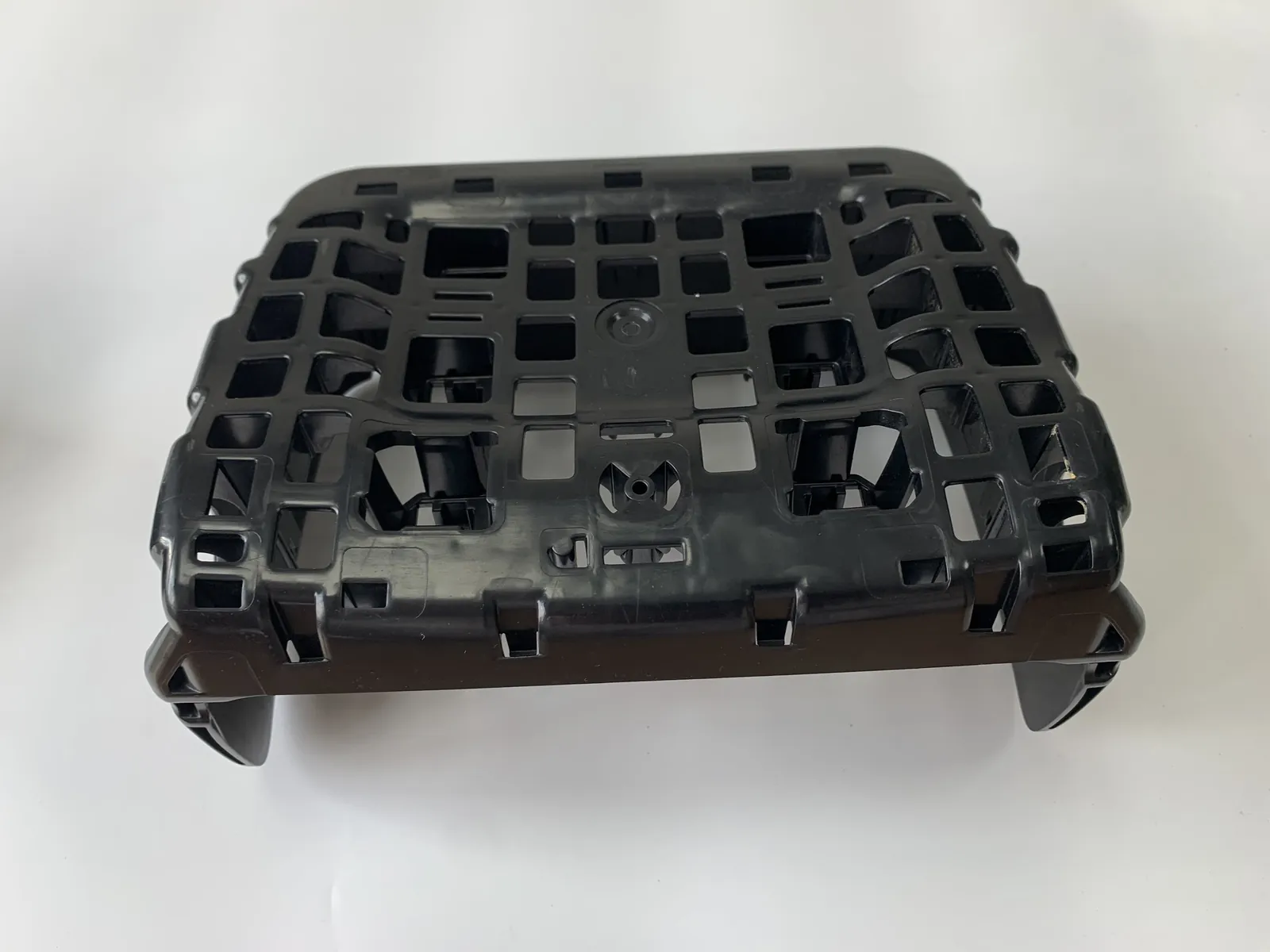
Which machine suits a low-flow resin?
A low MVR value raises the injection pressure the cavity needs, and the press has to deliver it. Machine choice follows the same two checks for every grade: projected area for clamp tonnage and shot weight against barrel size. Our moulding floor holds eleven presses rated between 80 and 450 T of clamping force, and the largest cell pairs a JSW press with a take-out robot to keep repeat orders stable.
Barrel occupancy matters as much as tonnage. Covestro recommends keeping the shot between 30 and 70 percent of cylinder capacity, a rule our metering stroke article works through in detail. A high-flow PA66 sitting in a hot barrel for a long residence time degrades; a low-flow PP needs the pressure headroom a correctly sized barrel gives.
Drying sits upstream of all of this. PA66 at MVR 40 only flows like a 40 if it is dry; wet nylon flows worse and splays. Our drying article lists the moisture limits per resin family.
But the press is only half of the match. A grade that flows easily on a big runner can still short-shot a thin wall if the gate chokes early. Trial data, not datasheet numbers alone, closes that loop.
Limitations
Datasheet flow is a laboratory number. The MVR test pushes melt through a straight die at a fixed temperature and weight. A real cavity adds shear, mould temperature, wall thickness and flow path length, and those move the effective flowability in both directions. Treat the datasheet value as a screening number, not as a filling prediction.
Every value belongs to one grade. The five flow values are grade-level typical values published by the resin makers, not measurements of ours and not family averages. The SABIC value was confirmed through the official-domain search result because the server blocks automated requests; the other four came straight from official pages over HTTP 200. The tooling rules come from the LANXESS and DuPont guides and hold in direction, not as universal constants.
What this means for your RFQ
Three lines decide how fast and how accurately a tool gets priced: the exact grade name, the MVR or MFR value with its test condition, and a link to the datasheet. With those in hand, the gate class, the wall check and the press match all happen before the quote, not after the first trial. An MVR value carries its condition with it, or it carries no meaning at all. Where the part is thin-walled or the cavity count is still open, a fill study answers it faster than a trial shot, and that decision is set out in when mold flow analysis earns its line item.
We help project buyers turn drawings into gate plans before steel is ordered. Send the 3D file, the resin grade and its datasheet to info@hongqiangmould.com — we price the tool within 24 hours and put the gate plan next to the number. The datasheet shrinkage line matters here too; our shrinkage article shows how we size cavities by it.
Graded | Gated | Quoted.
Frequently asked questions
What does MVR on a resin datasheet tell me? It tells you how much melt passes through a standard die in ten minutes under a fixed temperature and weight. The value is a grade-level typical number, not a promise. Read it together with its condition, because the same grade scores differently at 2.16 kg and at 5 kg.
Why do similar resins show very different MVR values? Because datasheets quote the test condition next to the value, and those conditions differ across suppliers. Loads of 1.2, 2.16, 3.8 and 5 kg appear across the five datasheets in this article. Compare two numbers only when temperature and load match, as in the PA66 pair measured at 275 °C and 5 kg.
Does a high melt flow rate always make a mould cheaper? Not always. Easy-flow resin fills thin walls at lower pressure and suits small gates, which can simplify the tool. Very high flow grades flash more readily, so the parting line and venting need tighter work. Gate class, wall and machine must be judged together, and the datasheet condition stays part of that judgement.
What resin information should a mould RFQ contain? Three lines make a quotation accurate: the exact grade name, the MVR or MFR value with its test condition, and the datasheet itself or a link to it. With those in hand, the toolmaker can fix the gate class, check wall feasibility and match the press before pricing. Drawings alone leave all three open.
Jack works on the tooling and molding team at Hongqiang Mould, a mould shop in China that builds injection moulds and runs production moulding on 11 presses from 80 to 450 T. He writes about the numbers behind tooling decisions: clamp force, cooling, ejection and the tolerance stack that decides whether a part assembles.