
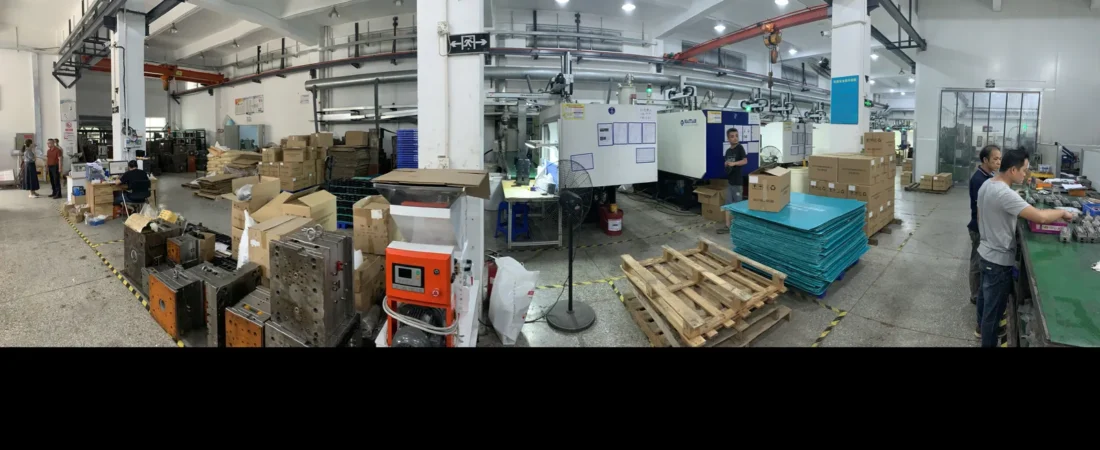
A 40 g connector and a 1.2 kg housing can need the same press. Clamp force follows projected area × cavity pressure — not the number on the weighing scale. Here is how our 11-press shop (80–450 T) sorts a part into a machine.
Most RFQs we receive quote a part weight first. It is the easiest number to find — every CAD file has it. It is also the number that decides the least.
Two parts of the same weight can land four machine sizes apart. A thin, wide cover spreads its pressure over a large projected area. A thick, narrow block concentrates the same pressure into a small one. The press sees area, not mass.
Suppliers quote tonnage differently. Some list the machine they happen to have free. Some quote the largest press they own to look safe. Some simply repeat what the last factory told the buyer. The number changes, the part does not.
Our machine list spans 80 to 450 T across eleven presses. Over those sizes, one rule holds: projected area decides the machine; weight only tells you whether the part fits a cycle time you can afford.
Below we set out how we sort a part into a press, the cavity pressures we see by resin, and the four numbers worth settling before tooling starts.
Key takeaways
- Clamp force: projected area × cavity pressure. Part weight never appears in the calculation.
- Real number: a 1.2 kg housing with 312 cm² of projected area at 600 bar needs about 187 t — our 250 t press, not the 450 t.
- Resin spread: cavity pressure varies roughly 2.5× across common grades — PP near 300–400 bar, glass-filled PA near 500–800 bar.
- Cavity count: two cavities double the projected area. Four quadruple it. Either can move the job up two machine sizes.
- Cost of guessing: undersizing shows up as flash at the parting line. Oversizing shows up in part price — you pay for the plate, not the pressure.
Methodology
Two data sources are used, and we keep them separate.
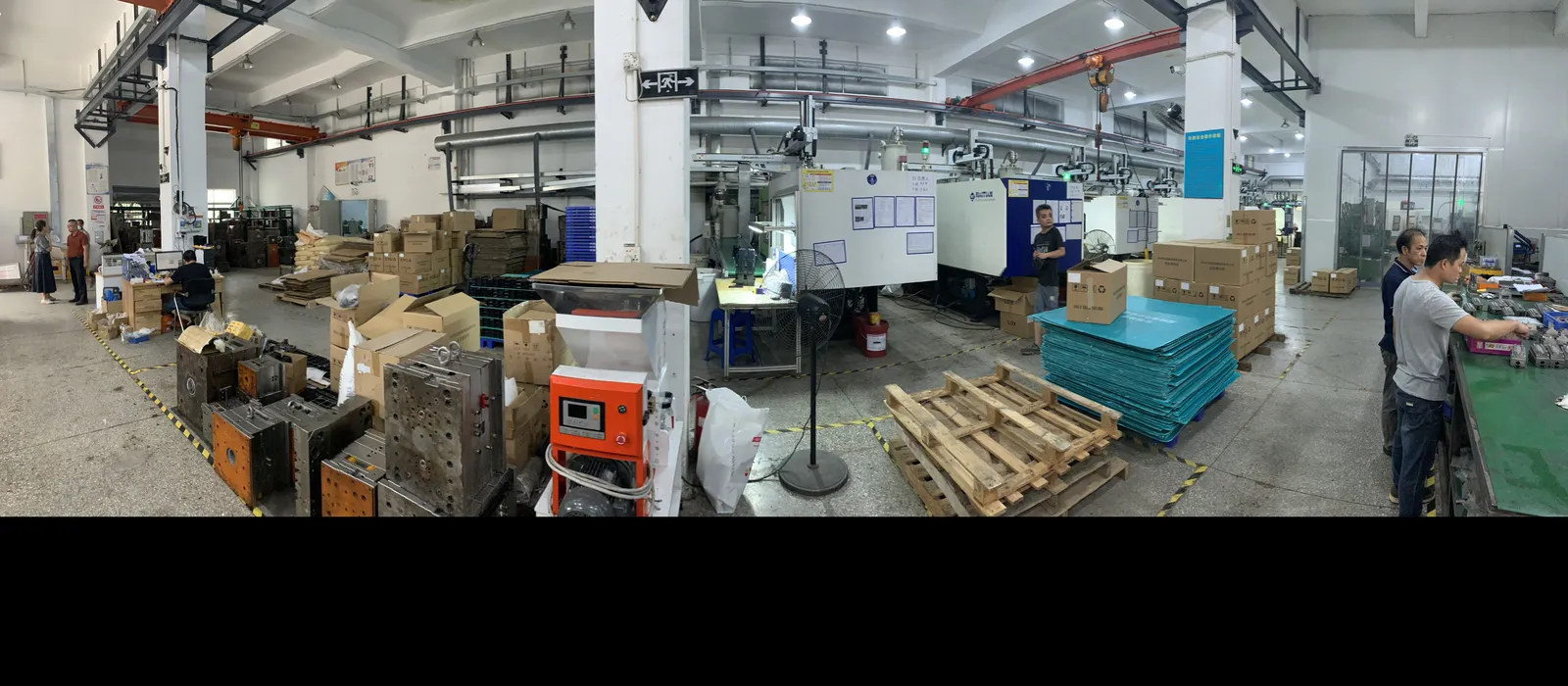
Shop records (ours). Machine list, clamping range and tooling scope come from our own production floor: eleven presses across 80 to 450 T, five CNC machining centres, EDM, surface grinding and a bridge CMM. Material grades and lead times follow our standard process sheet.
Industry-typical values (not ours). The cavity-pressure ranges by resin are published industry figures, not measurements taken on our machines. We label them industry-typical throughout. We did not run a laboratory study for this article, and we do not present published ranges as our own test results.
Where a figure is ours, it is stated as ours. Where it is industry-typical, it carries that label. Nothing in between.
What part sizes does an 80–450 T shop actually cover?
Machine size sets the ceiling, not the rule. A part lands in a band, not a single press — the mould base, shot weight and cycle time all shift it within that band.
| Press band | Typical part profile | Projected area (single cavity) |
|---|---|---|
| 80–120 T | Small connectors, clips, small covers | Up to ~80 cm² |
| 150–250 T | Handheld housings, meter covers, small boxes | ~80–250 cm² |
| 280–380 T | Appliance panels, medium enclosures | ~250–450 cm² |
| 400–450 T | Large enclosures, structural frames | ~450–650 cm² |
From a 40 g connector to a 1.2 kg housing, the band — not the weight — picks the press. Our 450 T machine runs with a take-out robot, so larger parts come out without hand-picking them from the platens.
Why does a tall rib push a part into a bigger machine?
Cavity pressure is what the melt pushes back with while it fills. It is set by the resin, the wall thickness and the flow length — not by the part weight.
| Resin | Cavity pressure (industry-typical) | Effect on clamp force |
|---|---|---|
| PP | ~300–400 bar | Lowest of the common grades |
| PE | ~300–400 bar | Similar to PP, easy flow |
| ABS | ~350–500 bar | Mid-range, the usual baseline |
| PC | ~500–700 bar | Roughly 1.5× ABS |
| PA (unfilled) | ~500–700 bar | High, fast-setting |
| PA / PBT (glass-filled) | ~500–800 bar | Highest; drives machine size up |
Switch a cover from ABS to glass-filled PA and the clamp force climbs by roughly half at the same projected area. Keep the resin, add a tall stiffening rib, and the flow length grows — pressure rises again. Either way, the machine moves up. Weight barely changes.
What should be settled in the RFQ?
- Projected area per cavity, in cm² — including runners if they fall inside the parting-line footprint.
- Cavity count. Two cavities double the area; four quadruple it. This is the fastest way to change the machine size.
- Resin grade, filled or unfilled. Glass-filled PA and PC are not ABS with a different price tag — they change the press.
- Part weight and wall thickness. These set shot size and cooling time. They tell us cycle time and cost, not clamp force.
Limitations
Three limits worth stating plainly.
One: the pressure figures are industry-typical. They are published ranges, not our measurements. Real cavity pressure depends on gate location, wall-thickness transitions and mould temperature, and can sit outside the range for an unusual part. We treat them as a starting point for machine selection, then confirm on the trial.
Two: the band table is directional. It assumes a reasonable gate and a balanced fill. A badly gated part can move up a size on its own.
Three: 11 presses is our shop, not the industry. The bands reflect our machine list and the parts we run. A different shop with a different spread would draw the bands slightly differently.
We are not a laboratory. Final machine selection is confirmed by the mould trial and adjusted by the DFM review, not by a table alone.
Performance data. The cavity-pressure ranges shown above are published industry figures measured under controlled conditions. Real values shift with gate location, wall thickness and mould temperature. Treat them as a starting point, not a guarantee.
Third-party information. Resin grades and pressure ranges are drawn from publicly available manufacturer and industry documentation as of the publication date. We do not represent them as our own test results.
What this means for your RFQ
Projected area first. Cavity count second. Resin third. Weight last. That order settles the press in one round of questions instead of three.
Send us the drawing and the resin grade. We check the projected area against our 80–450 T machine list, run a manufacturability pass, and come back with a quotation within 24 hours. Send 2D/3D files to info@hongqiangmould.com or message us on WhatsApp.
Accurate | Repeatable | On Schedule
Frequently asked questions
Does part weight decide which press the mould runs in? No. Clamp force follows projected area multiplied by cavity pressure, and part weight never appears in that calculation. Two parts of the same weight can land four machine sizes apart: a thin, wide cover spreads pressure across a large projected area, while a thick, narrow block concentrates the same pressure into a small one.
How do I estimate projected area for a new part? Take the footprint the part casts on the parting plane, in square centimetres, and include runners if they sit inside that footprint. Then multiply by the cavity count – two cavities double the area, four quadruple it. This is the first figure worth putting in the RFQ, because it moves machine size fastest.
What clamp force does a glass-filled PA housing need? Worked example: a housing with 312 square centimetres of projected area running glass-filled PA at about 600 bar needs roughly 187 tonnes of clamp force (312 x 600 / 981). That lands in our 250 T press, not the 450 T machine. The pressure figure is industry-typical and gets confirmed on the trial.
What does an undersized or oversized press actually cost me? Undersizing shows up at the mould rather than on the quote: the parting line lifts under cavity pressure and flash forms. Oversizing shows up in part price, because you pay for the platen and the machine hour, not for the pressure the part truly needs. Settling projected area and cavity count first avoids both.