

We help buyers keep tooling production-ready between runs. A mould that leaves the press warm and parks in cool, humid air condenses water on its own steel — dew point, not calendar time, sets the schedule. ISO 8502-4’s 3 °C margin shows when, and five restart checks decide whether the first shot after storage is worth booking.
Nobody rings us about the mould that is running. The calls come when a programme pauses, and nearly all of them ask about calendar time: how long can the tool sit, and what does six months on a rack do to it?
One side says storage is passive: steel does not age, the tool was approved, the next batch should look like the last. The other side keeps brushing rust preventive onto cavities, wrapping tools in VCI film and capping water ports — routines that make no sense unless something active is threatening the steel.
The number missing from that argument is the dew point of the room. Cool the steel below it and an invisible water film forms within hours; keep the steel above it and the same shelf is safe. Corrosion follows the temperature gap, not the calendar.
We set out to answer four questions:
- When does a stored mould actually start to corrode?
- Which room conditions turn an idle tool into a wet one?
- What do the five restart checks catch before the first shot?
- How should storage duration change the protection a buyer asks for?
Built on the condensation rules the coating industry standardised in ISO 8502-4 and on the restart checks our shop runs for stored customer tooling: the clock starts when steel drops toward the room’s dew point — at 26 °C and 80% RH that is 22.3 °C, so a mould idling at 24 °C holds a margin of only 1.7 °C against a 3 °C rule — and five checks (surface, parting line, ejection, cooling circuits, first article) decide whether the restart batch ships. The calendar sends the bill. Condensation does the damage.
Key takeaways
- Damage trigger: condensation begins the moment steel falls below the room’s dew point — 22.3 °C in 26 °C air at 80% RH.
- Working margin: ISO 8502-4 practice keeps the surface at least 3 °C above dew point; a 24 °C idle mould in that room holds only 1.7 °C.
- Worst case: a 22 °C tool in 30 °C coastal air at 90% RH sits 6.2 °C under the dew point — visible sweating, not a theory.
- Restart proof: five checks — steel surface, parting line and vents, ejection, cooling flow, first article against the drawing.
- Protection grade: scale it to the storage span; VCI packaging is rated by its maker for up to 2 years indoors.
Methodology
Two kinds of evidence sit behind this article, and they deserve different levels of trust. The shop-side facts — that customer moulds are stored, maintained and serviced here between runs, and that every incoming tool passes a documented inspection stage before work starts — come from our published capabilities and services pages, re-checked against the live copy on 2026-10-09. Capacity references use the same published lists: eleven presses from 80 to 450 T, the largest fitted with a take-out robot, plus five CNC machining centres.
The dew point figures are calculations, not measurements. Each value comes from the Magnus approximation with the constants published by Alduchov and Eskridge in 1996 — the same formula family behind the dew point table in ISO 8502-4, Annex A, and accurate to roughly ±0.35 °C between −45 and 60 °C. The 3 °C surface margin is the coating industry’s standard working rule from the same standard; some offshore specifications raise it to 5 °C.
Where a habit is common practice rather than our documented routine — per-cavity first articles, VCI packaging grades — the text says so. We have run no corrosion study of our own. We do not need one for the point that matters: the threshold is published physics, and anyone can recompute the table below.
Why does a warm mould sweat in a cool room?
Because a mould stays cold long after it stops looking cold. When the run ends, the cooling water goes off, but the tool still holds a large chilled steel mass; surfaces near water lines can sit several degrees under room temperature for hours. Air always carries some moisture, and the dew point is the temperature at which that moisture can no longer stay dissolved — every surface below it collects water.
Industrial painters learned to manage exactly this risk on exactly this material, and they wrote it down. ISO 8502-4 exists to estimate the probability of condensation on steel before coating, and it publishes the dew point as a function of air temperature and relative humidity. The table below is computed with the same formula family.
| Air temperature | 50% RH | 60% RH | 70% RH | 80% RH | 90% RH |
|---|---|---|---|---|---|
| 18 °C | 7.4 °C | 10.1 °C | 12.4 °C | 14.5 °C | 16.3 °C |
| 22 °C | 11.1 °C | 13.9 °C | 16.3 °C | 18.4 °C | 20.3 °C |
| 26 °C | 14.8 °C | 17.6 °C | 20.1 °C | 22.3 °C | 24.2 °C |
| 30 °C | 18.4 °C | 21.4 °C | 23.9 °C | 26.2 °C | 28.2 °C |
| 34 °C | 22.1 °C | 25.1 °C | 27.8 °C | 30.1 °C | 32.1 °C |
Pick one cell. A 26 °C workshop at 80% RH wets any steel below 22.3 °C. A tool fresh off chilled water runs colder still.
From last shot to cold evening, the gap can close within the hour. Humidity decides how fast.
But the table assumes still air, steady temperature and bare steel. Drafts, doorway traffic and residue films that trap moisture all move the real threshold.
Which side of the 3 °C margin is your idle mould on?
Painters answer that question before every shift: no coating goes onto steel closer than 3 °C above the dew point, because a damp surface destroys adhesion. A stored mould takes the same test with higher stakes — nobody inspects the cavity until the first defective part appears. The scenarios below take ordinary plant conditions and ask one question: is the steel far enough above the dew point?
| Room conditions | Dew point | Mould surface | Margin | What it means |
|---|---|---|---|---|
| 26 °C, 80% RH | 22.3 °C | 20 °C, chilled zones right after shutdown | −2.3 °C | Wet steel — condensation now |
| 26 °C, 80% RH | 22.3 °C | 24 °C after an idle hour | +1.7 °C | Below the 3 °C rule — still at risk |
| 30 °C, 90% RH | 28.2 °C | 22 °C cold tool, coastal summer | −6.2 °C | Visible sweating |
| 22 °C, 55% RH | 12.5 °C | 12 °C chilled core, “dry” plant | −0.5 °C | Cold cores sweat in dry plants too |
| 18 °C, 50% RH | 7.4 °C | 24 °C warm tool, heated plant | +16.6 °C | Comfortable margin |
Negative margins mean a water film. A water film on bare steel means flash rust by the morning shift.
Chilled cores are the trap worth naming. A plant that feels dry still wets a 12 °C core overnight.
These margins come from paint-shop practice rather than moulding trials. The steel physics is identical; the inspection gap after storage is what makes it more dangerous here.
What do the five restart checks catch?
Protection and evidence are different jobs. Rust preventive keeps water off the steel during storage; the restart check proves nothing crept past it while the tool sat. Every tool that arrives here passes a documented incoming inspection, and a customer mould returning from our storage rack goes through the same gate. Four of the five checks are inspections. The fifth produces evidence you can file, the way a first article does in any inspection report.
| Check | What it catches | What a pass looks like |
|---|---|---|
| Steel surface and cavities | Condensation film, flash rust, pitting starting inside texture | No film on a white wipe; no bloom under raking light |
| Parting line and vents | Residue hardened over idle weeks; high spots that print flash | Faces seat clean; vents open after a brass-brush pass |
| Ejection, slides, guides | Grease dried to varnish; pins binding after humidity swings | Plate returns by hand through full stroke without catching |
| Cooling circuits | Standing water, scale, plugs left in the ports | Both circuits flow clear; nothing pools after draining |
| First article vs drawing | Anything the visual checks cannot see | One shot per cavity, every dimension on the report (per-cavity is industry-typical) |
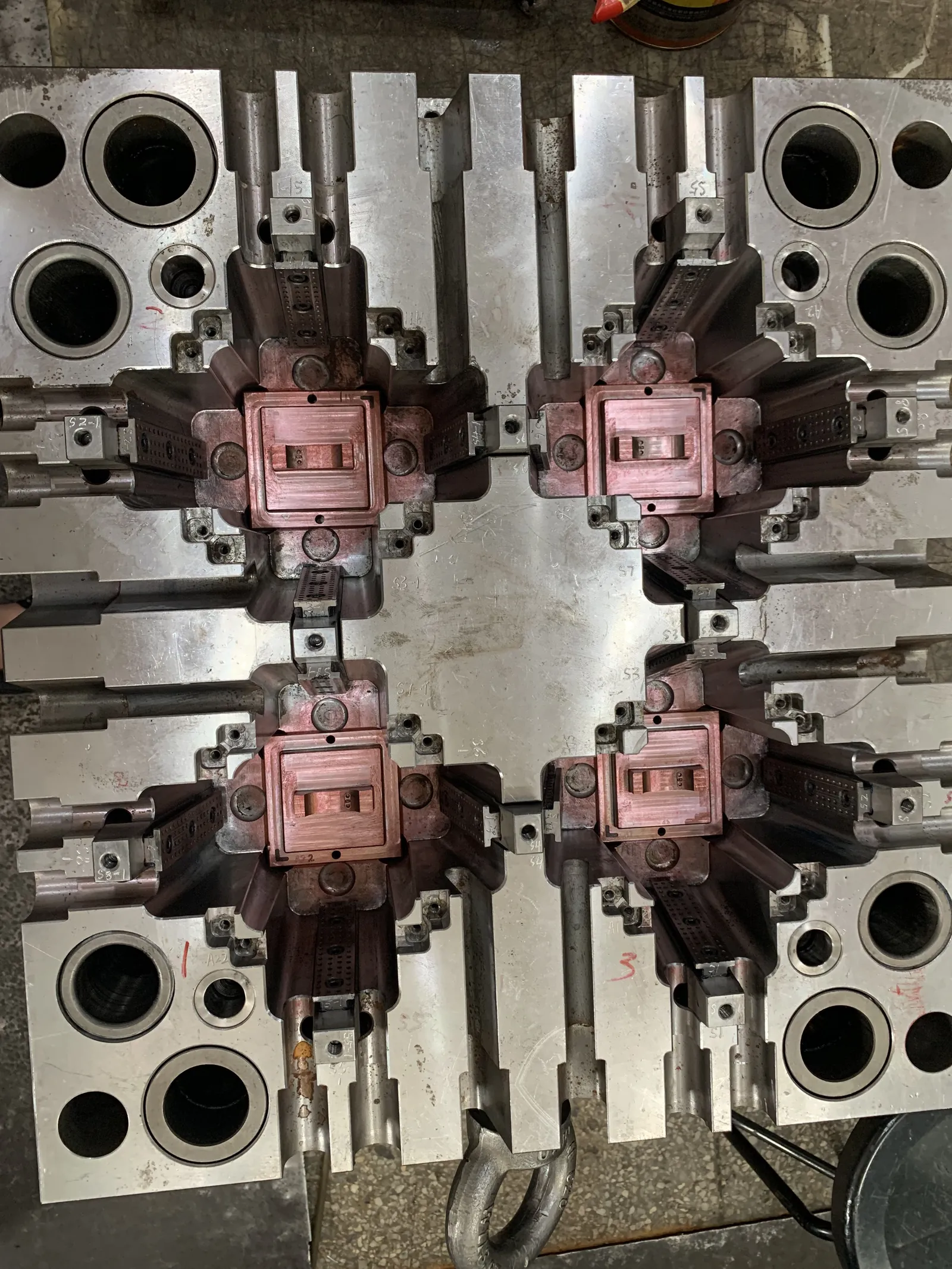
The first four are inspections. The fifth is the measured proof a buyer keeps.
Molding here records process parameters batch by batch, so a restart pulls its setup from the stored record of the last good run. The tool comes back to the press with numbers attached, not guesses.
How should storage duration change the protection you ask for?
Rust preventive is not one product. Suppliers grade protection by how long the steel must survive, and the grade drives both cost and cleanup. The spans below are supplier guidance rather than our shop documents — which is exactly why a buyer can hold a moulder to them by writing the storage span into the RFQ.
| Storage span | Protection practice | Source note |
|---|---|---|
| Days to weeks | Light oil film on steel, tool stored closed, ports capped | Supplier guidance (Stoner Molding Solutions) |
| 1–6 months | Hard-film rust preventive or wax on cavities, VCI wrap, desiccant in the enclosed space | Supplier guidance (Stoner Molding Solutions) |
| 6–24 months | VCI packaging rated for long-term indoor storage, periodic re-inspection, full re-preservation after any trial | Maker rating: VpCI-277 to 2 years indoors (Cortec Corporation) |
| Any span | Cooling circuits drained and dried before the tool goes on the shelf | Supplier guidance (Stoner Molding Solutions) |
Match the film to the calendar. Heavy wax over a two-week gap wastes cleanup; light oil over a two-year gap wastes the tool.
Whatever sits on the steel comes off before the first shot. VCI film inside a closed tool is the designed exception — it protects without touching the moulding surfaces.
Limitations
The dew point table assumes still air, level temperatures and bare steel. A working plant offers none of the three: doorway traffic swings the humidity, drafts chill corners, and residue films hold moisture against the surface. Measure the margin at the tool, not on the thermostat.
The 3 °C rule, the Magnus constants and the VCI duration ratings are published standards and supplier documents, not our test results. We have run no corrosion-rate study on stored tooling, and nothing in this article should be quoted as one.
What this means for your RFQ
Storage does not bill by the month. It bills the moment warm steel meets cool, humid air — and the bill lands on whichever side did not write the storage terms down.
We help buyers keep tooling production-ready between runs: in-house storage and servicing for customer moulds, a documented restart check on every tool that leaves the rack, and molding on eleven presses from 80 to 450 T with capacity matched to the part.
Send your 3D drawings and your storage window to info@hongqiangmould.com — a quotation comes back within 24 hours. WhatsApp works too; the button is on every page. Tools that restart clean are built, stored and checked one way: Dry | Checked | Ready
Frequently asked questions
How long can an injection mould sit in storage before it is damaged? There is no calendar limit — damage follows condensation, not time. A tool kept dry, closed and protected with the right grade of rust preventive for its storage span can sit for years, while a warm tool parked in cool humid air can start corroding within hours of shutdown. The protection grade and the restart checks decide the outcome.
At what humidity does a stored mould start to rust? No single humidity number decides it. Steel corrodes when its surface reaches the dew point of the room: at 26 °C and 80% RH that point is about 22.3 °C, so a 22 °C mould sweats even in a room that feels dry. ISO 8502-4 practice keeps the steel at least 3 °C above the dew point.
What must be done before a stored mould runs again? Five things: wipe-test the steel for film or flash rust, clear the parting line and vents, confirm ejection and slides move freely, prove both cooling circuits flow, and shoot a first article measured against the drawing before the batch is booked. Storage protection comes off the steel first.
Should rust preventive be removed before production starts? Yes. Storage protection is engineered to cling to steel, and whatever clings to a cavity prints onto the parts. Clean the cavities and cores, wipe the parting line, then run a first article before booking the batch. VCI film inside a closed tool is the exception most suppliers design for: it protects without contacting the moulding surfaces.
Jack works on the tooling and molding team at Hongqiang Mould, an injection mould manufacturer and plastic injection molding supplier. The shop runs 11 presses from 80 to 450 T, 5 CNC machining centres and a metrology room with bridge CMM inspection.