
← Back to Blog · A 5% Undercut Is the Strip Line, Until Glass Fibre Cuts It to 1% (3 Resin Families)
We help buyers settle one tooling question before steel is cut: does this undercut leave the core by itself, or does it need moving steel. Three published resin limits decide that. Acetal strips to 5% of its diameter, unreinforced nylon reaches 6 to 10%, and glass-filled nylon stops at 1 to 2%.
The question usually arrives in one line. A product engineer sends a housing model and asks whether the internal snap hook needs sliders. The hook is 1.2 mm deep on a 24 mm bore, which sounds small until someone divides it.
Two camps answer that email. The designer has read that small undercuts can be stripped, so the tool should stay simple. The toolmaker has seen a stripped hook come out with a white stress line, so the tool should get a lifter. Both statements are defensible, and both are incomplete.
The missing term is the material. A 5% undercut in acetal is routine. The same 5% in a 30% glass-filled polyamide is five times past the published limit. That part cracks at the hook root during ejection, not in service. The percentage alone never answers the question.
Here is the whole dataset in one stretch, before the sections that unpack it. Acetal homopolymer strips to 5% of the diameter, on circular sections only, with a bevel on the lip. Unreinforced polyamide 66 reaches 6 to 10%, and the allowance moves with wall thickness and diameter. Glass-filled polyamide drops to 1% from a 38 °C mould, and to 2% from a 93 °C mould. Past those lines the tool needs a lifter, a slide or a collapsible core. Each of those mechanisms is paid for in stroke: a 2 mm lateral release costs 14.2 mm of ejection at 8°, and 22.9 mm at 5°.
We set out to answer four questions for the buyers who send us those models:
- What does a percentage undercut actually measure, and on which diameter?
- Why does glass fibre cut the allowance to a fifth of the unfilled value?
- How much ejection stroke does a lifter need to clear a given undercut?
- Which undercuts never strip, whatever the percentage says?
The short version: the strip limit is a material property with a geometry condition attached. The lifter is a trigonometry problem with a wear problem attached.
Key takeaways
- 5% of the diameter: acetal homopolymer strips only on circular sections with a beveled lip; a rectangular undercut fails at the corners.
- 6 to 10% for unfilled PA66: the widest published strip window of the three families, and it narrows as wall thickness rises.
- 1% at 38 °C, 2% at 93 °C: glass-filled polyamide gains its whole allowance from a hotter mould, which is why mould temperature belongs in the RFQ.
- 14.2 mm of stroke: what a 2 mm lateral release demands at an 8° lifter angle; the same release at 5° demands 22.9 mm.
- 15° ceiling: the steepest lifter angle published as workable, and only with guides seated in the support plate.
- Two moving halves: split core pins and offset ejectors remove internal undercuts without any strip allowance at all.
Methodology
This article is built from three public design documents, not from our own trials. The strip allowances come from the DuPont design manual for engineering polymers and from the DuPont Delrin moulding guide. The lifter angle window comes from a structural design text for thermoplastics that reproduces the same undercut figures. The stroke table is our own arithmetic on the tangent relation, and it is labelled as such wherever it appears.
Our own contribution is narrower than a data study. We machine lifter pockets, slide ways and split-core joints in a toolroom with 5 CNC machines, sinking EDM, wire cutting and a surface grinder. Those mechanisms are then fitted and proved on presses from 80 to 450 T. That gives us a view on how the mechanisms behave in build and at trial. It does not give us a measured strip percentage for any resin, and we do not present one.
What does a 5% undercut actually measure?
An undercut is expressed as a percentage of the feature diameter, not as a depth in millimetres. The published formula is (A minus B) divided by B, times 100, where B is the nominal diameter and A is the diameter across the undercut. A 24 mm bore with a 1.2 mm lip therefore carries a 5% undercut. The same 1.2 mm lip on a 12 mm bore carries 10%.
| Field | Value |
|---|---|
| Undercut definition | (A − B) ÷ B × 100, as % of diameter |
| Acetal homopolymer, strip limit | ≤5% of diameter, beveled, circular section only |
| Unreinforced PA66, strip limit | 6–10%, varying with wall thickness and diameter |
| Glass-filled PA, 38 °C mould | 1% |
| Glass-filled PA, 93 °C mould | 2% |
| Geometry that blocks stripping | Rectangular section, sharp internal corners |
| Method once the limit is passed | Lifter, slide, split cavity, collapsible core |
Read the second and third rows together. The material changes the limit by a factor of five, and nothing else in the table moves it that far.
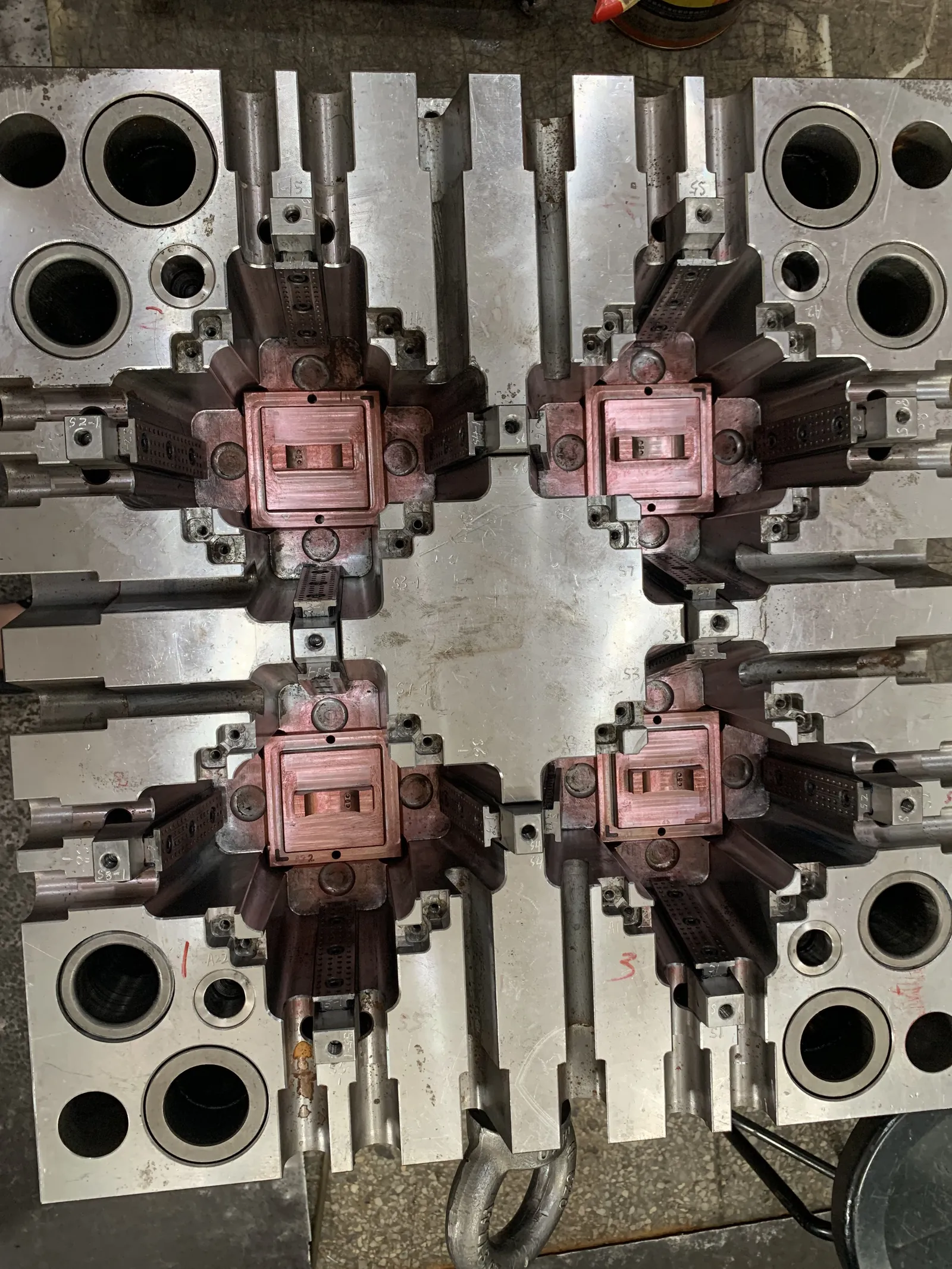
The unit matters more than it looks. Buyers often quote an undercut in millimetres because that is how the CAD feature measures. Converting it to a percentage is the first check we run. It sometimes turns a 3 mm lip from small into 12% on a 25 mm boss.
Why does glass fibre cut the allowance to 1 to 2%?
Stripping works by bending the part elastically as it slides over the lip. The wall must stretch enough to pass the undercut and then return to shape. Glass fibre removes most of that stretch. The fibres do not elongate, and the ones crossing the undercut root act as stress risers when the wall is forced outward.
The supplier manuals reflect that in the numbers, and they add a second variable that buyers rarely send us: mould temperature. A glass-filled grade strips to 1% from a 38 °C mould and to 2% from a 93 °C mould. The part is simply more compliant when it leaves a hot tool. The same geometry that cracks from a cold mould can survive from a hot one.
| Mould temperature at ejection | Strip allowance, glass-filled PA | Practical reading |
|---|---|---|
| 38 °C (100 °F) | 1% | Cold tool, stiff part, tightest limit |
| 93 °C (200 °F) | 2% | Hot tool, compliant part, double the allowance |
| Above the strip window | Not applicable | Split cavity or collapsible core specified instead |
So the temperature setpoint becomes a tooling decision. Run the tool hot and the hook may strip. Run it cold for cycle time and the same hook needs a lifter.
This is also where mould design and part design part company. A hot tool costs cycle time on every shot. A lifter costs money once, in the tool, and then wears for the life of the programme. Neither is free, and the comparison belongs in the quotation stage rather than in the trial report.
How much ejection stroke does a lifter need?
A lifter converts vertical ejection into lateral release. The relation is a single tangent: tan of the lifter angle equals lateral travel divided by ejection stroke. Rearranged, the stroke you need equals the lateral travel divided by the tangent of the angle.
The lateral travel is the undercut depth plus a clearance allowance for machining and assembly error. We allow 0.5 to 1 mm of clearance on small features, which turns a 1.5 mm undercut into a 2 mm release.
| Lateral release required | 5° | 8° | 10° | 12° | 15° |
|---|---|---|---|---|---|
| 1.0 mm | 11.4 mm | 7.1 mm | 5.7 mm | 4.7 mm | 3.7 mm |
| 2.0 mm | 22.9 mm | 14.2 mm | 11.3 mm | 9.4 mm | 7.5 mm |
| 3.0 mm | 34.3 mm | 21.4 mm | 17.0 mm | 14.1 mm | 11.2 mm |
| 4.0 mm | 45.7 mm | 28.5 mm | 22.7 mm | 18.8 mm | 14.9 mm |
The table kills one common assumption. A shallow angle sounds gentler on the mechanism, and it is, but it multiplies stroke. A 4 mm release at 5° needs 45.7 mm of ejection. Many mould bases do not offer that without a taller ejector housing.
The published angle window runs from 5° to 10°, with 15° workable when the lifter is guided at the base in the support plate. Steeper angles raise the side load on the lifter body, and side load is what wears the guide and eventually fractures the head.
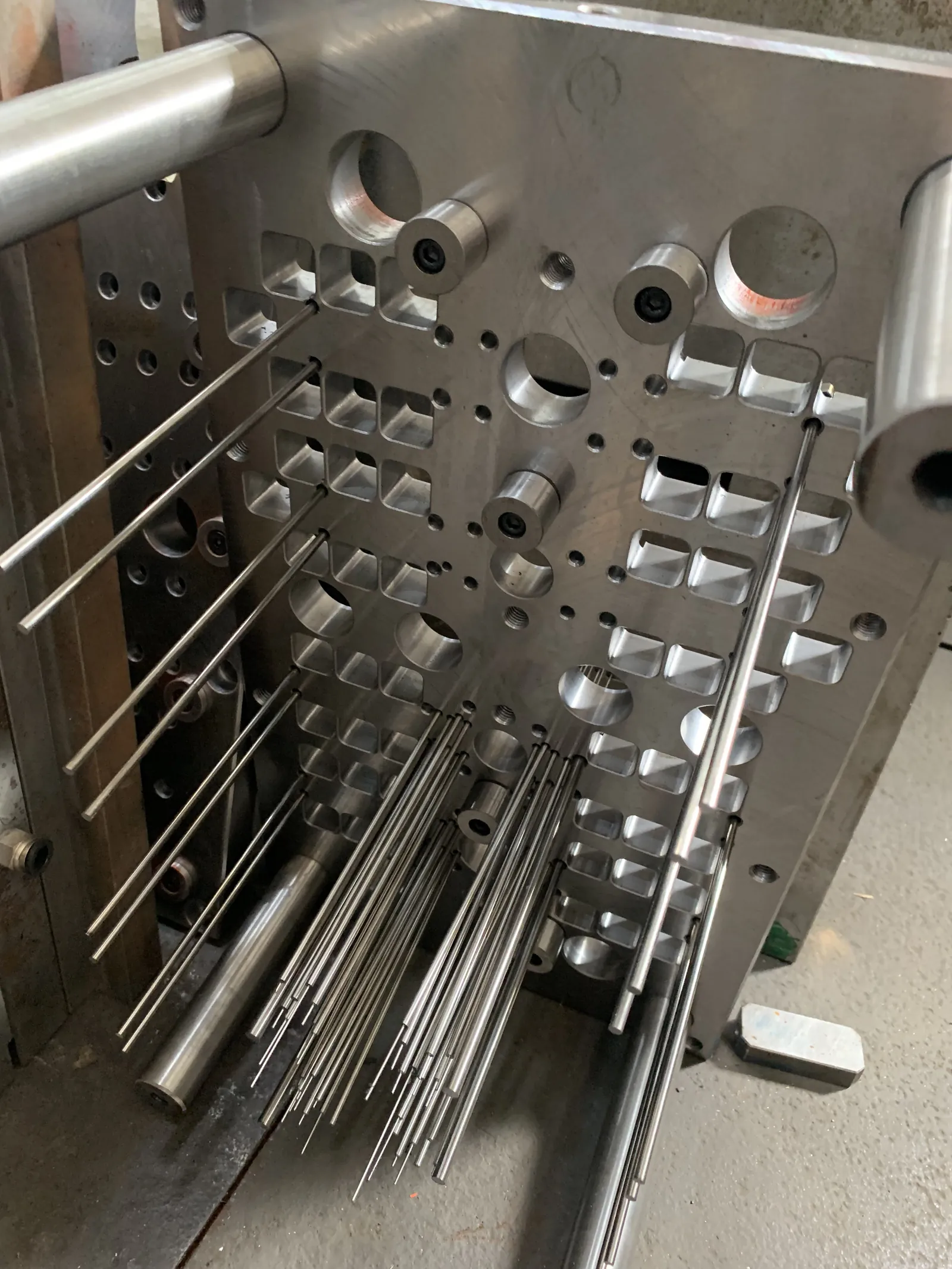
Stroke is therefore a mould base decision, made before the lifter is modelled. On a deep undercut the ejector housing grows and the return springs change. The base then has to be checked against the daylight of the press it will run in.
Which undercuts never strip, whatever the percentage says?
Some features sit outside the strip method entirely. An internal thread running the full circumference cannot be pulled over a lip, because the whole ring has to expand at once. Rectangular undercuts have the same problem at a smaller scale, since the corners concentrate strain before the walls can deflect.
| Feature | Method | What it adds to the tool |
|---|---|---|
| Internal hook, circular section, inside the strip limit | Strip from the core, lip beveled | Nothing mechanical; the risk moves into the part wall |
| Internal hook, past the strip limit | Lifter at 5–10° | Lifter pockets, guided ejection, longer stroke |
| External undercut of any depth | Slide on an angle pin with a heel block | Mould base extension, wear plates, locking heel |
| Full internal thread or full ring undercut | Collapsible core or unscrewing core | Highest moving-part cost in the tool |
| Shallow undercut on an adjoining wall | Split core pins or offset ejector pin | Flash control at the joint line |
Note the second row against the first. The lifter buys allowance, and it buys it with maintenance. Every lifter is a sliding pair running dry-ish inside a hot tool, and it needs grease and periodic inspection.
Split core pins deserve more attention than they get. Two pins meeting on the undercut’s centreline form the feature without any strip allowance and without any side action. The cost is a joint line inside the part, where flash has to be held to the same tolerance as the visible surface.
Limitations
These percentages are supplier recommendations, not test results. No ISO or ASTM method defines a strip test for undercuts. The numbers therefore describe what one resin maker found workable across its customers. They are not a measured threshold.
A workshop differs from the manual in ways the tables do not capture. Strip success also depends on the fillet at the lip, the polish on the core, ejection speed, mould temperature stability and the lubricity of the grade. A tool that strips 5% cleanly in one shop can mark the part in another with the same resin.
On sourcing: the strip figures trace to one supplier family, and the structural design text that repeats them credits the same origin. Two documents therefore do not equal two independent measurements, and we treat the limit as a starting point rather than a specification.
What this means for your RFQ
When a model reaches us with an undercut, we convert depth to percentage on the actual feature diameter and compare it against the resin you named. That single division decides whether the quotation contains a lifter, a slide or nothing at all, and it is why the resin column on our RFQ form is not optional.
Two details are worth sending with the model. Name the mould temperature you expect in production, because a glass-filled grade doubles its allowance between a cold and a hot tool. Name the undercut geometry as well, since a rectangular lip behaves nothing like a round one at the same percentage.
The line we hold: a percentage is a starting point, a mechanism is a cost, and the trial is where both get checked.
Email the 3D model with the resin grade noted to info@hongqiangmould.com. The quotation returns inside 24 hours and it names every undercut that strips, plus the ones that need moving steel. Design, toolroom, press floor and CMM room share one building: 11 presses from 80 to 450 T, 5 CNC machines, EDM, wire cutting, grinding and inspection. Accurate | Repeatable | On Schedule.
Frequently asked questions
Can a 5% undercut be stripped in glass-filled nylon? No. Glass-filled polyamide is published at 1% from a 38 degree mould and 2% from a 93 degree mould, so 5% is well outside the window. That feature needs a lifter, a split cavity or a collapsible core, and the quotation will carry the mechanism cost.
Does a lifter always cost more than stripping? Yes in tool cost, and no in part cost. A lifter adds pockets, guided ejection and a longer stroke to the mould. Stripping adds nothing to the tool but loads the part wall on every cycle, so a marginal undercut can cost scrap instead.
How is undercut percentage measured on a non-round feature? Use the local radius at the feature as the base dimension. The published formula divides by a diameter, so a rectangular lip is compared against its smallest local radius. Sharp corners usually rule out stripping before the percentage is even reached.
What ejection stroke should I allow for a lifter? Divide the lateral release by the tangent of the lifter angle. A 2 mm release at 8 degrees needs 14.2 mm of stroke, and the same release at 5 degrees needs 22.9 mm. Add the part height to that figure when checking the mould base.
Which resin gives the most stripping room? Unreinforced polyamide 66, published at 6 to 10% of the diameter, is the widest of the three families here. Acetal follows at 5% with a circular geometry condition, and glass-filled grades sit far below both at 1 to 2%. Wall thickness and diameter still move the pa66 figure inside that range. Wall thickness and diameter still move the pa66 figure inside that range.
Jack works on the tooling and molding team at Hongqiang Mould, a mould shop in China that builds injection moulds and runs production moulding on 11 presses from 80 to 450 T. He writes about the numbers behind tooling decisions: clamp force, cooling, ejection and the tolerance stack that decides whether a part assembles.