
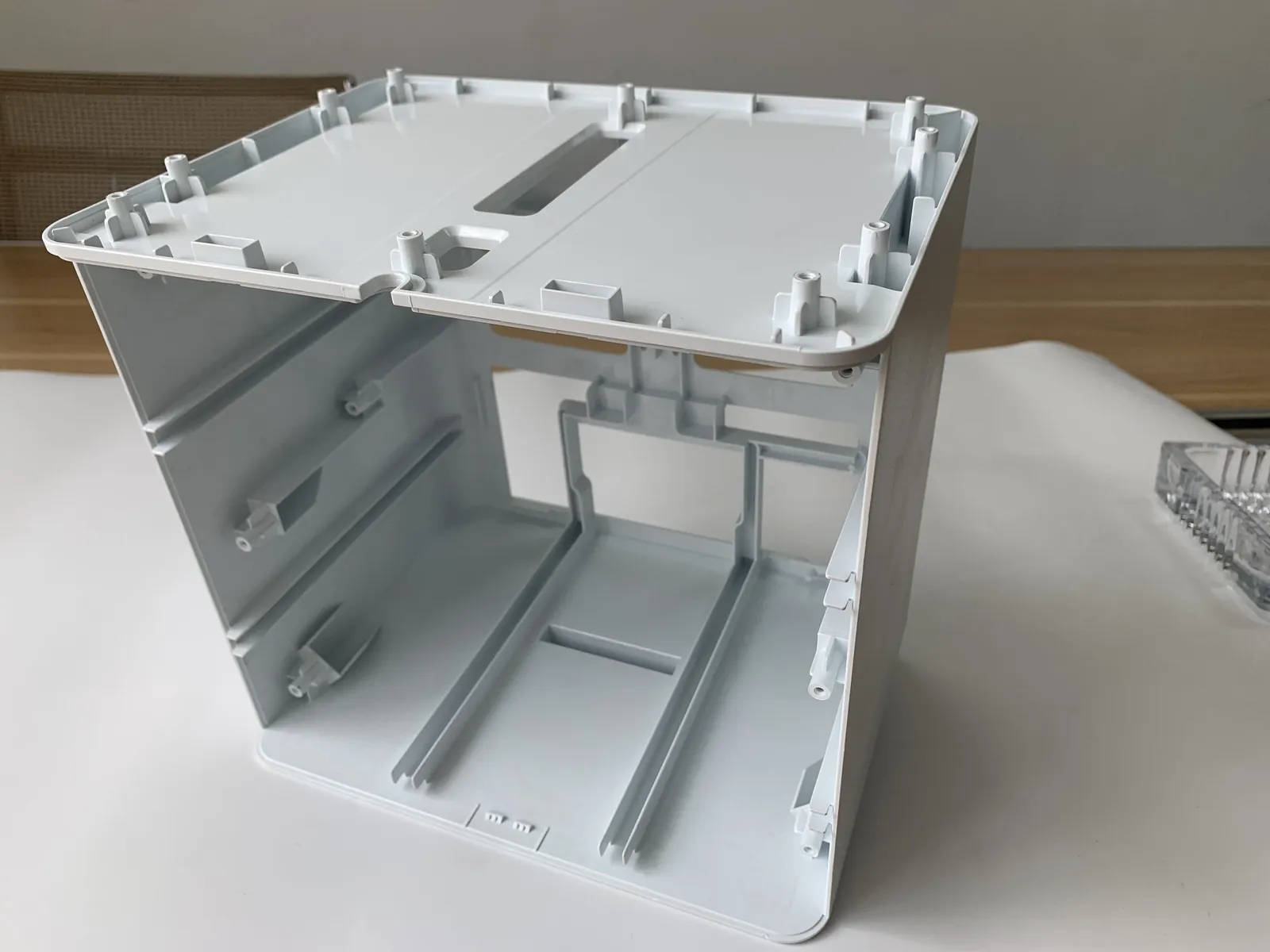
Design guides permit ribs at 50–60% of wall thickness, yet sink marks still show opposite ribs on gloss surfaces. A peer-reviewed polycarbonate study measured the safe rib at 0.25–0.34 of the wall. The difference hides in the rib root, where fillets stack extra thickness.
A buyer sends a housing drawing where every rib measures 60 percent of the wall. The guides look satisfied. Two trials later, the gloss panel opposite the mounting ribs still carries shallow dents, and nobody in the meeting agrees on which number went wrong.
One camp points at moulding guides that accept 50 to 60 percent of wall as rib thickness. The other camp answers with a 2013 study that moulded real polycarbonate specimens and measured the sink depth on the opposite face.
Both camps quote real sources, and the numbers still disagree. Each source answers a different question: structural adequacy on one side, a sink-free appearance on the other.
We set out to answer three questions:
- What rib ratios do published design guides actually specify?
- What ratio did a measured, peer-reviewed test support on gloss polycarbonate?
- What does the gap mean for a drawing before a mould quote?
Based on the published guides, one measured study and the mould-design records of our shop, the safe rib is decided by the root circle, not by the rib ratio alone.
Key takeaways
- Guide range: 50–75% — general design guides accept rib thickness between 50% and 75% of the wall; the 75% end suits low-shrink resins only.
- Measured optimum: 0.25–0.34 — the peer-reviewed gloss-PC study measured sink depth directly and placed the optimum rib at 0.25–0.34 of the section thickness.
- Root limit: 1.25× wall — keep the largest circle that fits at the rib root within 1.25 times the wall, or the local mass sinks the opposite face.
- Fillet cost: 1.23→1.75 — the same rib grows its root from about 1.23 to 1.75 times the wall when a thick rib carries an equally thick fillet.
- Local cooling: up to 3.1× — a 1.75× root solidifies about 3.1 times slower than the nominal wall under the square-law cooling relation.
Methodology
Three published sources are cross-checked here against one another and against the mould-design records of our shop, so no single guideline stands alone.
Source one is the design-guide compilation from Tangram Technology, a UK plastics consultancy, whose rib rules trace back to the Rapra compendium and to DuPont proportions. Source two is General Design Principles for DuPont Engineering Polymers, the 136-page DuPont guide, accessed through a public mirror. Source three is the 2013 paper by Jeong in the Journal of Mechanical Science and Technology, which moulded dedicated polycarbonate specimens and recorded actual sink depths with a Box-Behnken response-surface design.
Shop facts here cover our own 11-press moulding floor (80–450 T) and the resins we run in-house: PP, PE, ABS, PC and PA. Every converted or derived figure carries the label “our calculation”, and no measurement is claimed where none was taken. Numbers from the guides keep their published form.
What do the design guides actually specify?
The two guides agree with each other within a few percent on every rule that matters. Table 1 lists the published values side by side.
| Rule | Published value | Source |
|---|---|---|
| Rib thickness at the root | 50–75% of wall; 75% reserved for low-shrink resins | Tangram |
| Rib root total thickness | at most 1.25 × wall | Tangram |
| Fillet radius at the rib base | 40–60% of rib thickness | Tangram |
| Fillet radius at the rib base | one half of the rib thickness | DuPont |
| Rib depth | at most 5 × rib thickness | Tangram |
| Rib draft | about 1° per side | Tangram |
| Spacing of parallel ribs | 2–3 × wall or more | Tangram |
| Boss outside diameter | 2–2.5 × hole diameter | DuPont |
| Structural curves computed at | rib = 60% of wall | DuPont |
Read the two fillet rows together. The guides differ in wording, and they land on the same proportion. From a phone clip to an appliance housing, these six numbers decide whether the outer face stays flat.
But a table of ratios does not tell the entire picture, because the root grows faster than the rib does.
Which ratio did a measured test support?
The only peer-reviewed source we found that measured sink depth rib by rib is the 2013 study by Jeong. Its setup and findings fit in one small table.
| Item | Value |
|---|---|
| Resin | Polycarbonate |
| Surface under test | High gloss |
| Method | Response surface methodology, Box-Behnken design |
| Output measured | Actual sink depth opposite the rib |
| Dominant factor | Rib thickness |
| Optimum rib thickness | 0.25–0.34 × section thickness |
| Rib height and draft angle | Not major factors |
Thickness dominates the result. Height and draft barely move it. The study measured real moulded specimens, so the 0.25–0.34 window is evidence, not opinion.
But this optimum targets one strict goal: an invisible sink on a high-gloss PC face. Structural guides pursue load capacity instead, and the two goals are not the same target.
Why does a 60 percent rib still sink?
The answer sits where the rib meets the wall. Tangram defines the rib root by the largest circle that fits inside the junction, and that circle swells with the rib thickness and with the fillet radius. A thin rib with a 40 percent fillet leaves a root near 1.23 times the wall. A rib as thick as the wall, carrying an equal fillet, pushes the root to about 1.75 times the wall.
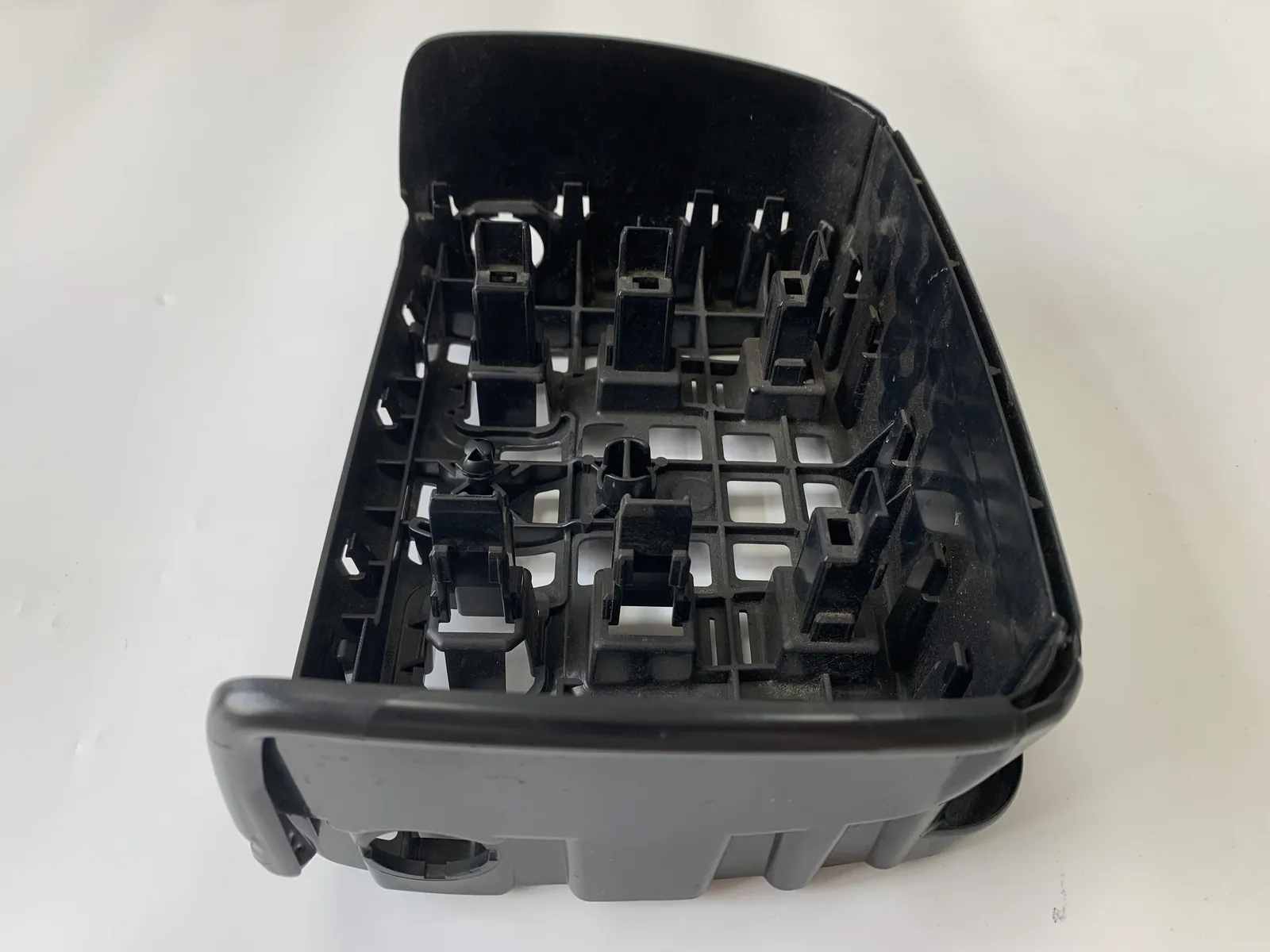
Where ribs cross, the junction thickens again, to about 1.3 times the wall at worst even when each rib obeys the rules. That local mass cools after the wall has frozen, and its contraction pulls the outer surface inward. The buyer sees the result opposite the rib, exactly where the drawing looked safe.
We converted the published root values into solidification penalties with the square-law cooling relation (our calculation). Table 3 shows the gap.
| Root thickness vs wall | Local solidification time vs wall |
|---|---|
| 1.23 × | about 1.5 × |
| 1.30 × | about 1.7 × |
| 1.55 × | about 2.4 × |
| 1.75 × | about 3.1 × |
The root freezes last. It also feeds the longest. Cut the root and the sink follows it down.
But this does not tell the entire picture. Deep ribs beat thick ribs on stiffness, because stiffness climbs with roughly the cube of depth. Tangram reprints the DuPont cross-ribbed calculator: a 2.5 mm ribbed wall matches a 5 mm solid plate at one rib per 31.25 mm of width, with the rib depth at 8.75 mm. Move the rib to 65 percent of the wall and the same stiffness fits at 20 mm spacing.
Appearance has a second lever. DuPont notes that a sink opposite a rib can be hidden by a textured surface or another interruption of the reflecting plane. We covered the texture-to-draft side of that trade in our texture-depth article, and the same grain that demands draft also scatters the reflection that would betray a shallow dent.

How should a rib look before you request a quote?
Six checks catch almost every rib problem while the part is still a drawing. Each one takes minutes in CAD.
- Ratio check: rib at or below 50–60% of the wall; on a gloss cosmetic face, start from 0.34 or lower.
- Root check: largest circle at the junction within 1.25 × wall.
- Fillet check: radius at 40–60% of the rib thickness, one half per DuPont.
- Depth check: rib no deeper than 5 × rib thickness; gain stiffness from depth, not thickness.
- Spacing check: parallel ribs at least 2–3 × wall apart, so the core between them can cool.
- Swap check: one thick rib becomes two or three thinner ribs carrying the same section.
In our 11-press shop (80–450 T), rib geometry gets fixed at mould design review, before any electrode or steel blank is cut. Changing a rib after the steel exists means welding, re-machining and a re-trial, so the six checks above cost hours now and save weeks later.
Limitations
Test conditions were narrower than production. The measured optimum came from a dedicated specimen tool, a single resin grade and controlled laboratory moulding; gate position, packing profile and mould temperature on a production part shift the sink depth in both directions. Our solidification multiples are geometry-based conversions under the square-law relation, not measurements on moulded parts.
Third-party figures carry their own scope. Tangram compiles its rules from the Rapra compendium and DuPont proportions; the DuPont guide reached us through a public mirror rather than a vendor portal; the 0.25–0.34 window was measured on polycarbonate only, and no other resin in our list of PP, PE, ABS, PC and PA has a published equivalent we could verify.
What this means for your RFQ
We help procurement teams carry a ribbed drawing from first review to a trial-ready mould without learning about sink marks on the first article. State in the RFQ which faces are gloss and which are hidden; we check the ratio, the root circle and the fillet stack at design review, while every change still costs minutes.
Ratio Set | Root Checked | Surface Clean
Send your 3D drawing to sales@hongqiangmould.com or use the WhatsApp button on any page. A drawing sent today gets its quotation inside 24 hours, with the rib-root feedback attached.
Frequently asked questions
What rib thickness ratio prevents sink marks? Published guides allow 50 to 60 percent of the wall for general parts. On a high-gloss polycarbonate face, a measured study put the optimum at 0.25 to 0.34. Check that the rib root circle stays within 1.25 times the wall, because the root rather than the rib alone drives the sink.
Why do sink marks appear opposite ribs on glossy surfaces? Differential shrinkage causes them. The rib root forms a local mass that cools after the wall has frozen, and its contraction pulls the opposite surface inward. A gloss finish reflects the shallow dent clearly, so the same depression reads stronger on a polished panel than on a matte one.
Does the fillet at the rib base make sink marks worse? It can, when it is oversized. The fillet is needed against stress concentration, yet every increase thickens the rib root. Keep it between 40 and 60 percent of the rib thickness, or one half of the rib thickness in the DuPont guide, and recheck the root circle after each fillet change.
Can packing pressure remove a sink mark behind an over-thick rib? No. Process changes reduce the depth, but a root that reaches 1.75 times the wall carries too much mass to pack out. Cut the rib or add a second thinner rib in the drawing; the fix belongs in CAD, not at the machine.
How deep can a reinforcing rib go? Keep rib depth within five times the rib thickness. Stiffness grows with roughly the cube of depth, which favours deep ribs, but deep thin ribs buckle under load, fill poorly and stick in the mould. Hold the spacing between parallel ribs at two to three wall thicknesses or more.
Jack works on the tooling and molding team at Hongqiang Mould, an injection mould manufacturer and plastic injection molding supplier. The shop runs 11 presses from 80 to 450 T, 5 CNC machining centres and a metrology room with bridge CMM inspection.