
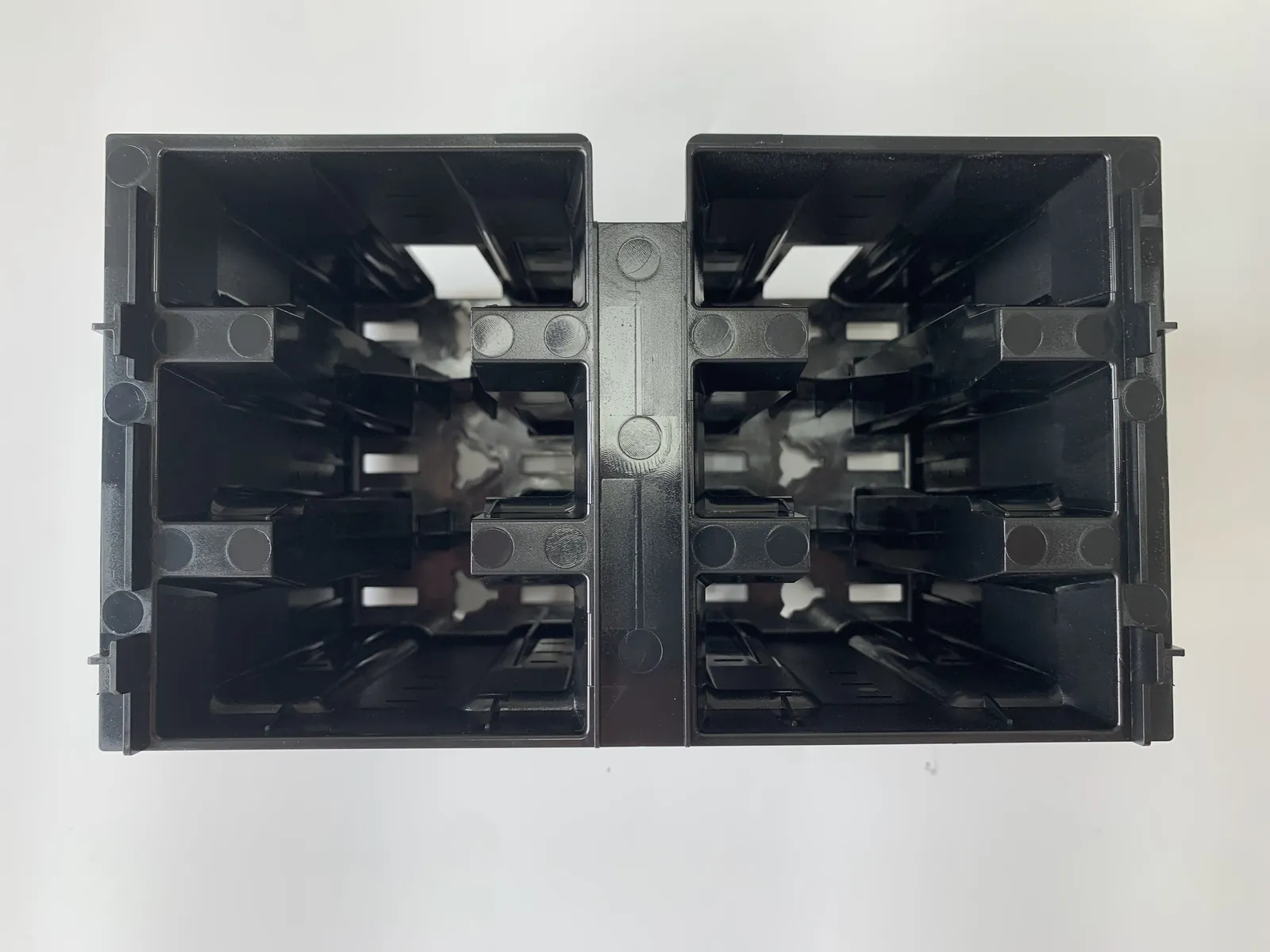
We help buyers price the channel that feeds their cavities before the tool is quoted. A full-round 6 mm runner, 120 mm long, holds 3.07 g of polypropylene. On a 12 g part that is 25.6% extra melt on every shot, for the life of the tool.
Runner weight rarely appears on a mould quotation. The document lists cavity count, steel grade and press tonnage. The channel that feeds those cavities stays invisible until the first trial shot drops a ring of cured plastic next to the parts.
One camp treats the runner as small change: grind it, blend it back, move on. The other camp pays a hot runner premium on instinct because a colleague once mentioned scrap percentages. Neither side has run the arithmetic on their own part weight.
The contradiction sits inside the RFQ itself. Buyers challenge a 0.05 mm tolerance to two decimal places, then approve a runner section nobody has written down, although that section moves resin consumption on every shot the tool will ever make.
We set out to answer four questions with nothing more than channel geometry and published datasheet values:
- What does a full-round channel of a given diameter and length hold, in grams?
- When does that weight become a visible share of a real part?
- How far does resin density move the same channel across PP, ABS, PC and PA66-GF30?
- Which sizing moves cut the channel before steel is cut?
The short version, in one paragraph: a 6 mm channel 120 mm long holds 3.07 g of polypropylene at 0.905 g/cm³, equal to 25.6% of a 12 g part and 6.8% of a 45 g part. The identical channel carries 4.61 g of PA66-GF30, or 461 kg of it per 100,000 shots. Shrinking the channel to 6 mm × 90 mm removes 68% of that mass before anyone touches a process parameter. The four tables below let you re-run every figure.
Key takeaways
- Channel size: a 6 mm full-round runner holds 3.07 g of PP per 120 mm; the same length at 8 mm holds 5.46 g, which is 78% more from two millimetres of diameter.
- Part weight sets the share: the identical 6 mm channel equals 25.6% of a 12 g part, 12.3% of a 25 g part and 3.4% of a 90 g part.
- Density moves the bill: one channel carries 3.07 g of PP, 3.53 g of ABS, 4.07 g of PC or 4.61 g of PA66-GF30 per shot.
- Cut before quoting: trimming an 8 mm × 160 mm branch to 6 mm × 90 mm takes the runner from 7.28 g to 2.30 g, a 68% reduction in resin.
- Melt beats solid: ABS lists 1.04 g/cm³ solid and 0.927 g/cm³ molten, so a weighed shot runs about 11% below the room-temperature estimate.
Methodology
Every gram in this article comes from geometry, not from a scale. The channel is a cylinder, so its volume is π times the radius squared, times its length, and mass follows once a density is applied. All tables assume full-round circular sections, the layout most toolmakers choose for balanced fill and low pressure loss.
Densities come from four supplier datasheets, each measured to ISO 1183 at 23 °C: SABIC PP 501SF at 905 kg/m³, Terluran GP-22 at 1040, Makrolon 2405 at 1200 and Ultramid A3EG6 at 1360. The datasheet names sit inside the resin table so each figure can be traced to its sheet.
Shop facts stay at equipment level: 11 presses from 80 to 450 T, with design, machining, mould trials and CMM inspection handled in one plant. No runner was weighed on a press for this article, and no shot weights were recorded for it. That omission is deliberate: every figure below can be re-derived with a pocket calculator, and none of it is offered as a weighed result from our floor.
What does a runner channel actually weigh?
Start with polypropylene at 0.905 g/cm³, the resin most cold-runner tools run. The table prices twenty common branch sizes in grams per shot.
| Channel length | Ø4 mm | Ø5 mm | Ø6 mm | Ø8 mm | Ø10 mm |
|---|---|---|---|---|---|
| 60 mm | 0.68 g | 1.07 g | 1.54 g | 2.73 g | 4.26 g |
| 90 mm | 1.02 g | 1.60 g | 2.30 g | 4.09 g | 6.40 g |
| 120 mm | 1.36 g | 2.13 g | 3.07 g | 5.46 g | 8.53 g |
| 150 mm | 1.71 g | 2.67 g | 3.84 g | 6.82 g | 10.66 g |
Diameter dominates the arithmetic. Two extra millimetres on a 6 mm channel add 78% to the mass at any length. But this does not tell the entire picture: length multiplies the same effect, and every branch in a multi-cavity tool repeats it once per cavity.
When does the runner outweigh the part it feeds?
Channel mass means little until it meets a part weight. The same 6 mm, 120 mm channel shifts from rounding error to headline cost as parts get lighter.
| Moulded part weight | Runner share of the shot |
|---|---|
| 8 g | 38.4% |
| 12 g | 25.6% |
| 25 g | 12.3% |
| 45 g | 6.8% |
| 90 g | 3.4% |
Small parts pay the ratio. Below roughly 25 g, the channel takes a double-digit share of every shot. That is the range where connectors, caps and small housings live.
What does one channel cost across four resins?
Geometry stays fixed; density does the rest. The table holds the channel at 6 mm × 120 mm and swaps the resin.
| Resin (datasheet) | Density, ISO 1183 | Mass per shot | Per 100,000 shots |
|---|---|---|---|
| PP — SABIC PP 501SF | 0.905 g/cm³ | 3.07 g | 307 kg |
| ABS — Terluran GP-22 | 1.04 g/cm³ | 3.53 g | 353 kg |
| PC — Makrolon 2405 | 1.20 g/cm³ | 4.07 g | 407 kg |
| PA66-GF30 — Ultramid A3EG6 | 1.36 g/cm³ | 4.61 g | 461 kg |
Glass fibre raises the loss by half against PP. Resin price then turns the same grams into a larger bill, because engineering compounds cost several times more per kilogram.
Put a year on it. At 200,000 shots, the loose 8 mm × 160 mm branch from the next section consumes 1,456 kg of PP; the trimmed 6 mm × 90 mm version consumes 461 kg. The difference is 995 kg. At an example price of $1.50/kg — substitute your own invoice figure — that is about $1,490 a year from one branch.
Does a hot runner erase this line? On material alone, rarely, at least for cheap resin in a small channel. Saving 3.07 g per shot is worth $4.61 per thousand shots at the example price, so an illustrative $12,000 system premium needs around 2.6 million shots to repay. Expensive resins, no-regrind rules and shorter cycles move that result; the formula above stays a first filter, not a verdict.
Which sizing moves cut the runner before steel is cut?
Because diameter and length multiply, neither lever alone captures the saving. The table starts from a deliberately loose 8 mm × 160 mm branch and trims it in steps.
| Branch channel (PP) | Mass per shot | Change vs 8 mm × 160 mm |
|---|---|---|
| 8 mm × 160 mm | 7.28 g | baseline |
| 6 mm × 160 mm | 4.09 g | −44% |
| 8 mm × 90 mm | 4.09 g | −44% |
| 6 mm × 90 mm | 2.30 g | −68% |
| 5 mm × 90 mm | 1.60 g | −78% |
Two moderate cuts beat one deep cut. Dropping 2 mm of diameter and 70 mm of length together removes 68% of the mass. Either move alone stops at 44%.
In our shop this decision happens at the 2D mould layout, before the first electrode is cut for the cavity details. A channel opens easily on a later machine; closing one means new steel. The limiter sits on the other side: the channel still has to carry packing pressure through gate freeze, and shear limits cap how small a filled compound can go. Those checks belong to the design review, and the resin-cost table above tells you what each candidate diameter costs per shot.
Limitations
Geometry prices an ideal channel and nothing else. A real feed system adds a sprue, cold slug wells, junction bulges and sub-runner branches, so a scale will read above the table in every real tool. Melt state pulls the other way: the ABS datasheet lists 1.04 g/cm³ solid and 0.927 g/cm³ molten, so weighed shot weights land about 11% under the solid-density estimate.
Third-party numbers carry their own limits. Densities come from four supplier datasheets at 23 °C, and grades inside one polymer family vary around those values. Every dollar figure uses an example resin price of $1.50/kg; treat the money column as a method, replace the price with your own, and only then compare it against a hot runner quotation.
What this means for your RFQ
The runner is the only component a mould machines, cools and ejects on every cycle, and the only one that never ships to a customer. Buyers who surface it at quotation get the cheap version of the conversation, while a diameter change still costs nothing. Four requests do most of the work:
- Send the 3D file with the part weight stated, plus the annual volume you plan to run.
- Ask that the quotation states runner diameter and total channel length per shot, not just the tool price.
- For family or multi-cavity tools, ask how branches are balanced and what each branch adds in grams.
- Where regrind is restricted, say so at quotation, because it changes the runner decision more than volume does.
| Item | Value |
|---|---|
| Presses | 11 injection machines, clamping 80–450 T |
| Robot coverage | 450 T press runs with a take-out robot |
| Toolmaking | 5 CNC centres, EDM, wire cutting, surface grinding |
| Layout stage | Runner section fixed on the 2D mould layout, before electrodes are cut |
| Trials | Mould trials run in-house on the presses that will produce the parts |
| Quotation | Back within 24 hours of receiving 2D/3D files |
We help buyers make that hidden mass visible at quotation, while a diameter change still costs nothing. Send your 3D drawing with the part weight and annual volume to info@hongqiangmould.com; a quotation with the runner section written out comes back within 24 hours. Light | Balanced | Visible.
Frequently asked questions
How much resin does a cold runner waste on every shot? The channel geometry and the resin density decide it. A full-round 6 mm channel 120 mm long holds 3.07 g of polypropylene, 3.53 g of ABS, 4.07 g of PC or 4.61 g of PA66-GF30. On an 8 g part that runner already carries 38.4% of the shot.
Does a hot runner always pay back at high volume? Not through material savings alone. At the example price of 1.50 dollars per kilogram, a 3.07 g polypropylene runner saves about 4.61 dollars per thousand shots, so an illustrative 12,000 dollar system premium needs roughly 2.6 million shots. Expensive resins, no-regrind rules and shorter cycles shift that result.
What runner diameter should my mould use? The channel must hold packing pressure long enough to feed the part, and stay small enough to cool with the cycle. Run the geometry check in this article for each candidate, then fix the size at design review against wall thickness, flow length and shear limits.
Why does a weighed runner disagree with the calculated weight? Two effects pull the scale away from the arithmetic. Real feed systems add a sprue, cold slug wells and branch junctions beyond the straight channel, and melt density sits below solid density, so ABS drops about 11 percent between the datasheet value at 23 °C and the molten state.
Jack works on the tooling and molding team at Hongqiang Mould, an injection mould manufacturer and plastic injection molding supplier. The shop runs 11 presses from 80 to 450 T, 5 CNC machining centres and a metrology room with bridge CMM inspection.